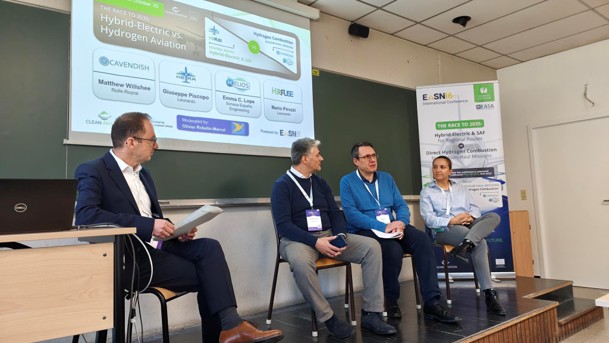
At the 16th EASN International Conference in Toulouse, experts from four pioneering Clean Aviation projects came together to address a question that is increasingly shaping the future of European aviation:
Which pathway is more likely to achieve certification by 2035, hybrid-electric aircraft powered with Sustainable Aviation Fuels (SAF), or hydrogen-powered aircraft?
Moderated by Olivier Robelin-Marcel from EASA, the debate brought together representatives from the HERA, represented by Giuseppe Piscopo, HERFUSE, represented by Mario Pirozzi, H2ELIOS,represented by Emma C. Lope and CAVENDISH, represented by Matthew Willshee projects to assess technology maturity, certification readiness, integration challenges, and regulatory considerations associated with the next generation of sustainable aircraft.
Looking Beyond Technology Readiness
While discussions on sustainable aviation often focus on technological breakthroughs, the debate highlighted a critical reality: reaching the required Technology Readiness Levels (TRLs) is only part of the journey. Equally important is progressing towards Certification Readiness Levels (CRLs), ensuring that innovative technologies can ultimately meet the stringent safety and operational requirements necessary for entry into service.
Four Projects, Four Perspectives
*HERA: Advancing Hybrid-Electric Regional Aviation (recapping Giuseppe Piscopo from the his participation to the online debate)
Representing the hybrid-electric pathway, HERA presented its vision for regional aircraft carrying 50 to 100 passengers on routes up to 500 km. Discussions focused on hybrid propulsion architectures, including mild hybrid and distributed propulsion concepts, alongside the continued importance of SAF in supporting aviation's transition toward lower emissions.
The project also addressed key integration challenges, including high-voltage systems, crashworthiness considerations, and the certifiability of increasingly complex aircraft architectures.
HERFUSE: Rethinking Aircraft Structures
HERFUSE highlighted the pivotal role that fuselage and empennage design will play in enabling future sustainable aircraft. The discussion explored how aircraft structures must evolve to accommodate both hybrid-electric propulsion and hydrogen storage, addressing challenges related to weight, volume, shape, materials, and crashworthiness.
Particular attention was given to hydrogen-ready configurations and the need for adaptable structural designs capable of supporting multiple energy carriers in the future.
H2ELIOS: Integrating Liquid Hydrogen on Board
The H2ELIOS project focused on one of the most challenging aspects of hydrogen aviation: the integration of liquid hydrogen storage systems into aircraft. Topics included tank sizing, mission requirements, maintainability, refuelling strategies, failure modes, and the certification implications associated with handling cryogenic fuels.
Speakers emphasized that while hydrogen offers significant environmental potential, introducing an entirely new fuel ecosystem requires substantial advances in aircraft integration, infrastructure, and safety validation.
CAVENDISH: Pushing the Boundaries of Hydrogen Combustion
Representatives of CAVENDISH presented progress on direct liquid hydrogen combustion technologies, discussing engine modifications, dual-fuel operational strategies combining hydrogen and SAF, and the lessons learned from extensive ground-testing campaigns.
The conversation explored the challenges of transitioning from successful ground demonstrations to fully integrated aircraft solutions while evaluating the environmental and operational implications of hydrogen-powered propulsion systems.
From TRL to CRL: The Real Challenge
A recurring theme throughout the debate was the need to bridge the gap between technological innovation and certification readiness. Participants discussed how emerging technologies introduce new operational and safety risks that must be identified, characterized, and mitigated as early as possible in the development process.
Experts agreed that anticipating certification requirements during the early stages of research can significantly accelerate development timelines and reduce barriers to market entry. This includes integrating certification considerations into system design, operational concepts, safety assessments, and technology roadmaps from the outset.
The role of regulators was also discussed extensively, with participants highlighting the importance of close cooperation between industry, research organisations, and certification authorities to ensure that regulatory frameworks evolve alongside technological progress.
Certification Readiness by 2035: Which Path Appears Most Likely?
While no unanimous answer emerged regarding which technology will be certified first, the discussion revealed that both hybrid-electric and hydrogen-powered solutions are progressing rapidly, albeit at different levels of maturity and complexity.
Hybrid-electric concepts benefit from leveraging existing aviation infrastructure and operational experience, while hydrogen technologies promise transformative environmental benefits but face additional challenges related to storage, infrastructure, aircraft integration, and certification.
Ultimately, the debate suggested that success will depend not only on technological advancement but also on the industry's ability to anticipate certification requirements, mature integrated solutions, and address emerging risks well before aircraft enter service.
A Shared Vision for Sustainable Aviation
Perhaps the strongest conclusion of the session was that sustainable aviation cannot be reduced to a competition between technologies.
As highlighted during the closing remarks, the future is not a binary choice between hybrid-electric and hydrogen-powered aircraft. Rather, multiple technologies are likely to coexist, supporting different mission profiles and market segments. Synergies between projects such as HERA, HERFUSE, H2ELIOS, and CAVENDISH will be essential for accelerating progress towards certification readiness and eventual entry into service.
The overarching message from the debate was clear:
Cooperation should prevail over competition. By working together to anticipate risks, develop standards, and support certification pathways, Europe's research and industrial communities can help bring the next generation of sustainable aircraft from concept to reality.
As aviation looks toward 2035 and beyond, collaboration across projects, industries, and regulatory bodies may ultimately prove to be the deciding factor in achieving climate-neutral flight.
*Due to serious personal reasons, the representative of the HERA project, Mr. Giuseppe Piscopo, was unable to attend the debate session at the 16th EASN International Conference. Nevertheless, his views and professional insights, previously shared during the online debate, are reflected in this article.
You can watch the online debate that took place on October 2 here.